
Previous style
What is the first-line drug for anaphylaxis?
Useful knowledge — too shallow as the backbone of a 2026 paper.
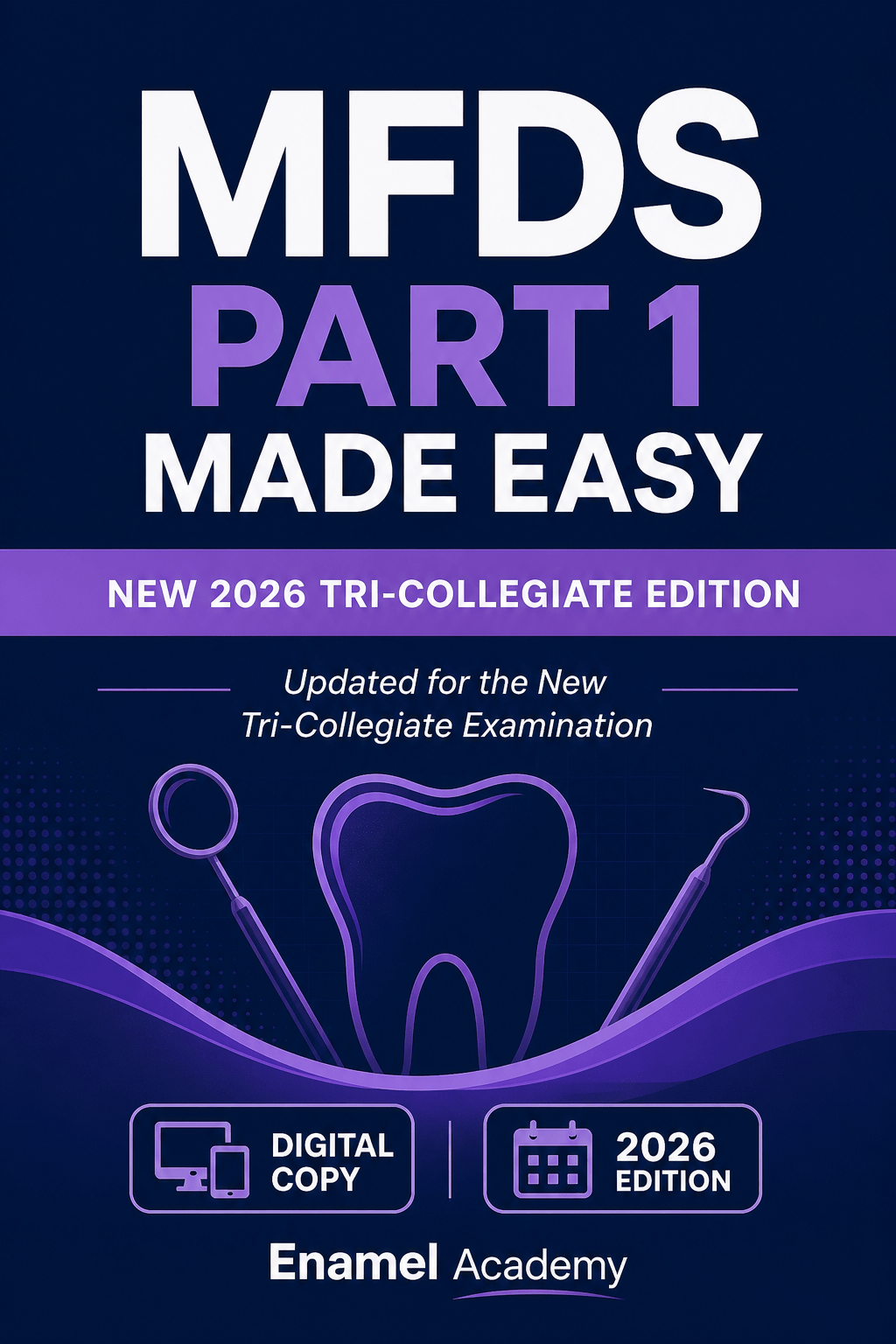
Updated for the New 2026 Tri-Collegiate MFDS Part 1 Examination
A new MFDS Part 1 revision guide, rewritten for the 2026 tri-collegiate examination and mapped to syllabus v1.3.
The revised paper is not a relabelled version of the old Part 1. Use this as a revision map: same dentistry, different demand. Always confirm the latest regulations with Dental Examinations Executive.
Read the full reform on the MFDS exam changes 2026 page, then confirm dates and regulations with Dental Examinations Executive.
Exam setup
How questions work
Syllabus coverage
An old-style revision question might test a fact. That knowledge still matters — it is too shallow as the backbone of a 2026 mock. A stronger Tri-Collegiate-style item gives you a patient, then asks for the single most appropriate next step.
What is the first-line drug for anaphylaxis?
A patient develops urticaria, wheeze, hypotension and breathing difficulty after receiving a drug. What is the single most appropriate immediate intervention?
What is IOTN?
Interpret an orthodontic scenario and understand what the index is being used to determine.
What is CBCT?
Conventional imaging has not answered the question. Is CBCT justified?
Define capacity.
A patient with dementia can understand, retain, weigh and communicate information. How should consent be handled?
Part 1 is two papers of 90 single-best-answer items, each lasting two hours. Five options. One best answer. First sitting: 28 October 2026.
Notes written for the previous college papers will not match the 2026 syllabus or the reasoning the new SBAs reward. This edition was rewritten against MFDS Exam Syllabus v1.3 dated 8 April 2026.
Updated and mapped to the new 2026 Tri-Collegiate MFDS syllabus.Subject-led coverage mapped to syllabus v1.3 — not a line-by-line reprint of every competency statement.
Build a structured understanding of the new tri-collegiate syllabus instead of jumping between leftover notes from the old paper.
Part-completion of the current MFDS does not carry over. Use a resource rewritten for the new Part 1 rather than recycling an old plan.
Use concise chapters and focused revision material to study efficiently around a busy schedule.
Read concise, clinically coherent subject chapters mapped to the 2026 syllabus.
Follow the reasoning behind diagnoses, investigations and management.
Work through clinical scenarios written for higher-order SBAs.
Use the self-assessment questions and worked answers to identify weak areas.
Opening-chapter previews: clinical concepts, high-yield revision, decision-making, worked scenarios and self-assessment.
This edition is organised as a dental revision textbook mapped to the 2026 Tri-Collegiate MFDS Part 1 syllabus. The syllabus is used as a coverage checklist, not as the chapter structure.
Related syllabus statements are taught together inside clinically coherent subjects so you can follow the reasoning the new SBAs are written to test.
Exact doses and regulatory requirements should always be checked against the current UK source close to the examination.
History taking is diagnostic work, not administration. The clinician is trying to convert a patient’s narrative into a problem representation: who the patient is, what has happened, over what time course, with which modifying factors, and with what consequences.
Begin with the presenting complaint in the patient’s own words. Establish onset, duration, site, character, severity, radiation, pattern, provoking and relieving factors, associated symptoms and previous episodes.
Describe before diagnosing. Record site, number, size, shape, colour, surface, border, base, consistency, fixation, tenderness, ulceration and associated lymphadenopathy.
| Discriminator | Why it matters |
|---|---|
| Age & duration | Separates chronic, acute and developmental patterns. |
| Vitality | Changes the endodontic versus other-tissue differential. |
| Systemic symptoms | Flags spreading infection or non-dental disease. |
| Radiographic pattern | Supports or challenges the clinical working diagnosis. |
A differential diagnosis is a ranked list, not a random catalogue. Start with common causes that fit the pattern, then ensure that serious diagnoses are not missed.
Presentation. A 58-year-old patient attends with a painful lateral-tongue ulcer. It has been present for more than three weeks. Smoking history is present. A previous clinician adjusted a denture and prescribed topical treatment.
Reasoning. A traumatic ulcer should improve after the cause is removed. Persistence beyond the expected healing period changes the risk assessment. Repeated symptomatic treatment without tissue diagnosis or referral is the diagnostic error to avoid.
Question. Antibiotics are most clearly indicated in odontogenic infection when:
Answer. C. Local measures and source control come first. Antibiotics are adjuncts for spreading infection, systemic involvement or another specific indication — they do not replace drainage or treatment of the cause.
Key learning point. Repeatedly changing antibiotics without controlling the source is unsafe.
Written for the decisions the 2026 paper actually tests.
This edition is mapped to Dental Examinations Executive MFDS Exam Syllabus v1.3 (8 April 2026). Related topics are taught together.
Focus on the information that changes diagnosis, treatment planning, prescribing, referral and patient safety.
See how knowledge is applied when the answer is not immediately obvious — the skill the new paper rewards.
A substantial question bank with worked answers to test understanding after studying the material.
Yes. This edition is updated and mapped to the new 2026 Tri-Collegiate MFDS syllabus (Dental Examinations Executive MFDS Exam Syllabus v1.3, 8 April 2026). It is an independent Enamel Academy resource, not an official or endorsed publication.
From October 2026, Part 1 is 180 single-best-answer questions across two papers of 90 questions, each lasting 2 hours. Each item has five options and one best answer. The first sitting is 28 October 2026. Confirm the latest regulations with Dental Examinations Executive.
No. It is a structured revision textbook mapped to the published syllabus. It does not replace official regulations, sample papers or current UK clinical guidance, and it does not guarantee a pass.
It is primarily a comprehensive MFDS Part 1 revision book, with a substantial self-assessment section and worked answers. Use it alongside SBA practice and official college materials.
Part-completion of the current MFDS does not exempt you from the new Part 1. This edition is rewritten for the 2026 paper rather than lightly patched from the old format. Read the MFDS exam changes guide on this site, then confirm your position with your college.
No. Exact drug doses, regulatory requirements and clinical guidelines can change. Candidates should always check current authoritative UK guidance close to the examination.
It is a digital copy from Enamel Academy. After checkout you receive instant access to download the book. It is not a printed paperback.
It is an independent digital revision resource from Enamel Academy. It is not affiliated with or endorsed by the Royal Colleges or Dental Examinations Executive.
Build the knowledge first. Then test whether you can apply it.
MFDS Part 1 Made Easy
2026 Tri-Collegiate edition · Digital copy · Enamel Academy
MFDS Part 1 Made Easy is an independent revision resource produced by Enamel Academy. It is not affiliated with or endorsed by the Royal Colleges or Dental Examinations Executive. Candidates should consult the official examination website for the latest syllabus, regulations and examination information.