What has changed for MFDS Part 1 2026
The new 2026 Tri-Collegiate MFDS Part 1 is a different examination. From October 2026 it is a single tri-collegiate paper at DCT3 standard, written for applied clinical reasoning rather than isolated recall.
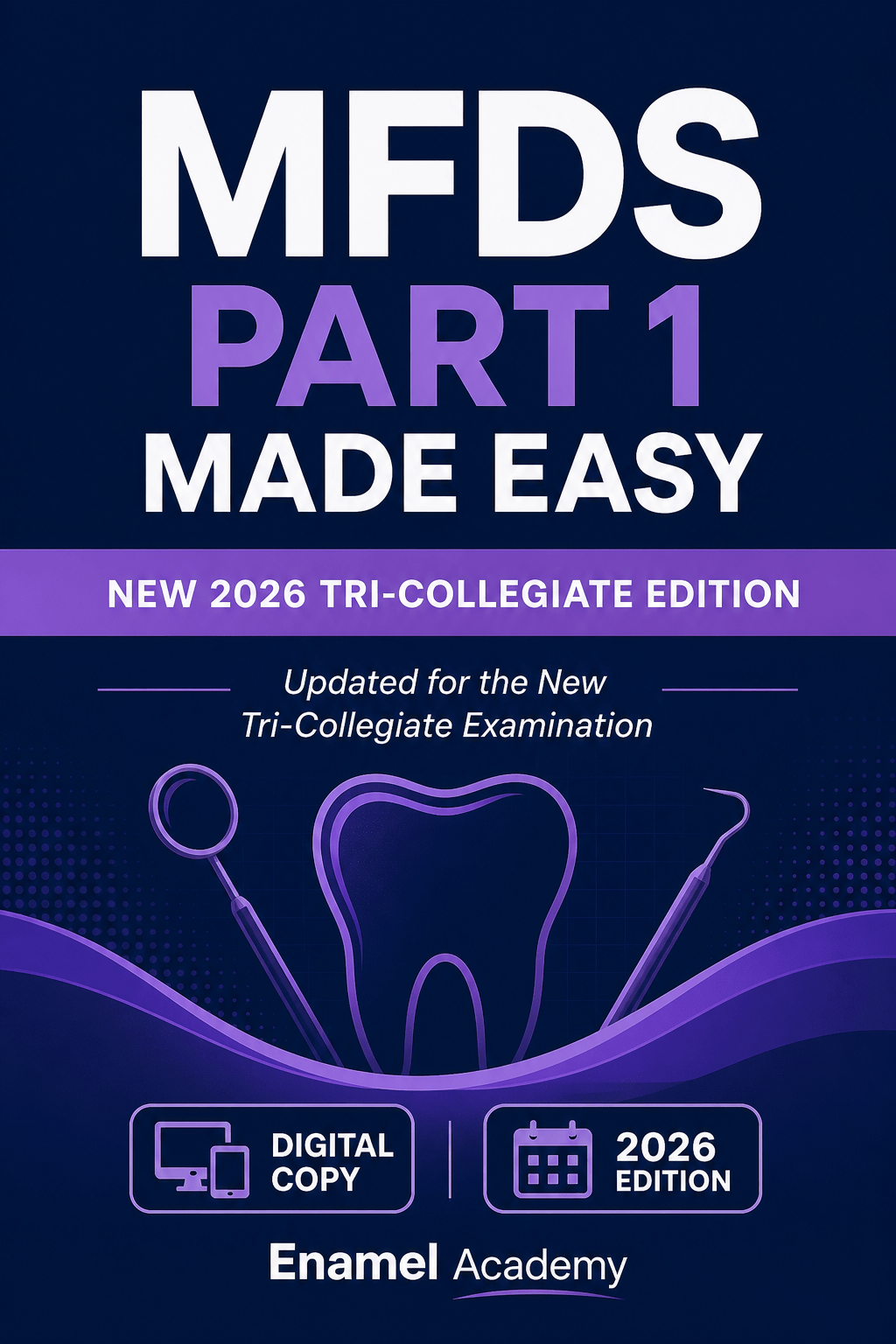
This edition of MFDS Part 1 Made Easy has been rewritten and mapped to Dental Examinations Executive MFDS Exam Syllabus v1.3 (8 April 2026). It is an independent Enamel Academy resource — updated and mapped to the new 2026 Tri-Collegiate MFDS syllabus, not an official college publication.
Previous Part 1 format
- Separate college examinations
- Heavy emphasis on factual recall
- Foundation-level standard
- One long written paper in many sittings
2026 Tri-Collegiate Part 1
- Single tri-collegiate examination
- Higher-order clinical reasoning
- DCT3-level standard
- Two papers × 90 SBAs × 2 hours each
Rewritten for the new syllabus
Subject-led coverage mapped to MFDS Exam Syllabus v1.3. Related topics are taught together so you can follow the reasoning the 2026 SBAs are written to test.
Clinical dentistry 13 topics
- History and clinical examination
- Diagnosis and clinical reasoning
- Caries
- Periodontology
- Endodontics
- Oral medicine
- Oral cancer
- Oral surgery
- Dental trauma
- Restorative dentistry
- Prosthodontics
- Paediatric dentistry
- Orthodontic principles
Medical & patient safety 9 topics
- Medical emergencies
- ABCDE assessment
- Prescribing
- Antibiotic stewardship
- Anticoagulants and bleeding
- Systemic disease
- Local anaesthesia
- Conscious sedation
- Medical risk assessment
Professional practice 9 topics
- Consent
- Capacity
- Confidentiality
- Ethics
- Record keeping
- Safeguarding
- Complaints
- Professional responsibilities
- GDC principles
Communication & leadership 8 topics
- Patient communication
- Shared decision-making
- Team communication
- Difficult conversations
- Referral
- Practice organisation
- Governance
- Clinical leadership
Who the 2026 edition is for
First-time candidates for the 2026 exam
Build a structured understanding of the new tri-collegiate syllabus instead of jumping between leftover notes from the old paper.
Candidates who started the previous format
Part-completion of the current MFDS does not carry over. Use a resource rewritten for the new Part 1 rather than recycling an old plan.
Dentists revising alongside clinical work
Use concise chapters and focused revision material to study efficiently around a busy schedule.
What you will learn
Three strands sit together: applied clinical dentistry, patient safety, and the professional decisions the paper actually rewards.
Applied clinical dentistry
Build the diagnosis, investigations, sequencing and referral thresholds that 2026 SBAs are written to test.
Patient safety and medical risk
Work through emergencies, prescribing, anticoagulation, systemic disease and the decisions that keep patients safe.
Professionalism and communication
Consent, capacity, ethics, safeguarding and team communication sit alongside the clinical chapters, not after them.
The MFDS Part 1 2026 format
Two papers. Ninety SBAs each. Two hours each. First sitting 28 October 2026. Confirm the latest regulations with Dental Examinations Executive.
See inside the book.
Representative pages from the opening chapters — clinical teaching, a classification table, decision-making, a worked scenario and self-assessment.
A dental revision textbook
This edition is organised as a dental revision textbook mapped to the 2026 Tri-Collegiate MFDS Part 1 syllabus. The syllabus is used as a coverage checklist, not as the chapter structure.
Related syllabus statements are taught together inside clinically coherent subjects so you can follow the reasoning the new SBAs are written to test.
Exact doses and regulatory requirements should always be checked against the current UK source close to the examination.
History taking and clinical reasoning
History taking is diagnostic work, not administration. The clinician is trying to convert a patient’s narrative into a problem representation: who the patient is, what has happened, over what time course, with which modifying factors, and with what consequences.
Begin with the presenting complaint in the patient’s own words. Establish onset, duration, site, character, severity, radiation, pattern, provoking and relieving factors, associated symptoms and previous episodes.
- For pain: spontaneous or stimulus-related?
- Does it linger? Does biting provoke it?
- Is sleep disturbed? Can the patient localise the source?
Describing lesions before diagnosing
Describe before diagnosing. Record site, number, size, shape, colour, surface, border, base, consistency, fixation, tenderness, ulceration and associated lymphadenopathy.
| Discriminator | Why it matters |
|---|---|
| Age & duration | Separates chronic, acute and developmental patterns. |
| Vitality | Changes the endodontic versus other-tissue differential. |
| Systemic symptoms | Flags spreading infection or non-dental disease. |
| Radiographic pattern | Supports or challenges the clinical working diagnosis. |
A differential diagnosis is a ranked list, not a random catalogue. Start with common causes that fit the pattern, then ensure that serious diagnoses are not missed.
Persistent ulcer — what matters
Presentation. A 58-year-old patient attends with a painful lateral-tongue ulcer. It has been present for more than three weeks. Smoking history is present. A previous clinician adjusted a denture and prescribed topical treatment.
Reasoning. A traumatic ulcer should improve after the cause is removed. Persistence beyond the expected healing period changes the risk assessment. Repeated symptomatic treatment without tissue diagnosis or referral is the diagnostic error to avoid.
Question and worked answer
Question. Antibiotics are most clearly indicated in odontogenic infection when:
- There is irreversible pulpitis without swelling.
- There is a localised abscess that can be drained and the source treated.
- There is spreading infection, systemic involvement, or another defined indication.
- The patient requests antibiotics instead of extraction.
Answer. C. Local measures and source control come first. Antibiotics are adjuncts for spreading infection, systemic involvement or another specific indication — they do not replace drainage or treatment of the cause.
Key learning point. Repeatedly changing antibiotics without controlling the source is unsafe.
MFDS Part 1 2026 FAQs
Is this book updated for the new 2026 Tri-Collegiate MFDS Part 1?
Yes. This edition is updated and mapped to the new 2026 Tri-Collegiate MFDS syllabus (Dental Examinations Executive MFDS Exam Syllabus v1.3, 8 April 2026). It is an independent Enamel Academy resource, not an official or endorsed publication.
What is the new MFDS Part 1 exam format?
From October 2026, Part 1 is 180 single-best-answer questions across two papers of 90 questions, each lasting 2 hours. Each item has five options and one best answer. The first sitting is 28 October 2026. Confirm the latest regulations with Dental Examinations Executive.
Does the book claim to cover everything in the exam?
No. It is a structured revision textbook mapped to the published syllabus. It does not replace official regulations, sample papers or current UK clinical guidance, and it does not guarantee a pass.
Is this an MFDS Part 1 revision book or a question bank?
It is primarily a comprehensive MFDS Part 1 revision book, with a substantial self-assessment section and worked answers. Use it alongside SBA practice and official college materials.
I started the previous MFDS format. Do I still need a new resource?
Part-completion of the current MFDS does not exempt you from the new Part 1. This edition is rewritten for the 2026 paper rather than lightly patched from the old format. Read the MFDS exam changes guide on this site, then confirm your position with your college.
Does the book replace current UK guidelines?
No. Exact drug doses, regulatory requirements and clinical guidelines can change. Candidates should always check current authoritative UK guidance close to the examination.
Is this a printed book or a digital copy?
It is a digital copy from Enamel Academy. After checkout you receive instant access to download the book. It is not a printed paperback.
Who is the book from?
It is an independent digital revision resource from Enamel Academy. It is not affiliated with or endorsed by the Royal Colleges or Dental Examinations Executive.
From Enamel Academy
An independent digital revision resource from Enamel Academy, written for dentists preparing for the 2026 Tri-Collegiate MFDS Part 1. This is a digital copy — instant access after checkout, not a printed book.
Get the updated MFDS Part 1 book
A structured 2026 Tri-Collegiate digital edition mapped to syllabus v1.3 — written for the knowledge that changes the answer.
Digital copy · Instant access after checkout · Enamel Academy
MFDS Part 1 Made Easy is an independent revision resource produced by Enamel Academy. It is not affiliated with or endorsed by the Royal Colleges or Dental Examinations Executive. Candidates should consult the official examination website for the latest syllabus, regulations and examination information.